
Measure Leadership Program ROI: A 2026 Metrics Guide
Stop guessing at leadership development. Learn the 3-layer framework to measure ROI through engagement, performance, and culture metrics in 2026.
Most organizations don't have a leadership development problem.
They have a measurement problem.
I've sat in NFL locker rooms, NFLPA negotiation rooms, and executive boardrooms. The pattern is the same in all three. Leaders confuse activity with progress, and program completion with program return.
Here is the truth—if you cannot measure leadership development program ROI, you are not investing.
You are donating.
This is the 2026 standard for HR and Learning & Development leaders who want to turn leadership training into measurable business outcomes. No theory. No fluff. A framework you can implement this quarter.
What is leadership development program ROI?
Leadership development program ROI is the measurable return an organization earns from its investment in leadership training, calculated by tracking changes in employee engagement, performance improvement, and organizational culture against the program's total cost.
The classic formula still holds:
ROI = (Net Program Benefits ÷ Program Costs) × 100
The formula is the easy part. The metrics underneath it are where most programs collapse. In 2026, the bar has moved. Boards are no longer satisfied with smile sheets and completion rates. They want execution and accountability tied to revenue, retention, and risk.
Why most leadership development programs fail to prove ROI
Three reasons. Every time.
- They measure activity, not behavior. Hours of training delivered does not equal leaders who behave differently on Monday.
- They measure too late. Annual surveys catch lagging indicators long after the program ends.
- They measure too narrowly. Engagement alone does not prove performance. Performance alone does not prove culture.
A high-performing program hits a number.
A high-functioning program builds a system that sustains the number.
One burns bright. The other builds something that lasts.
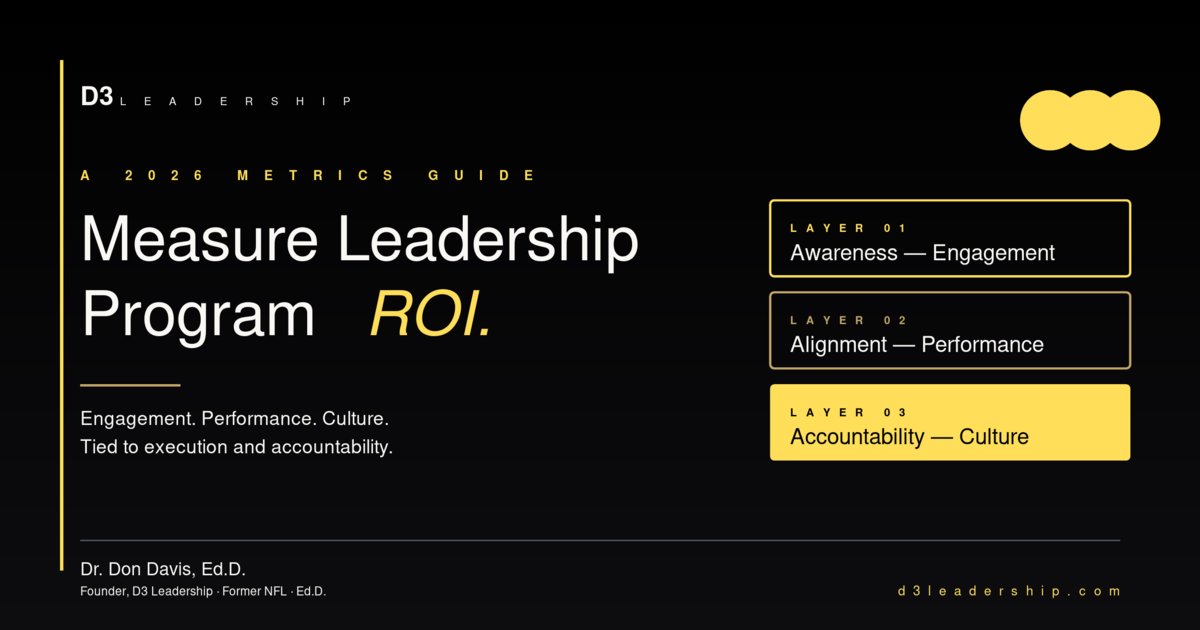
The 3-Layer Leadership ROI Framework
This is the model we use with every D3 Leadership client. It is the framework every L&D team should have on the wall.
- Layer 1 — Awareness: Engagement metrics
- Layer 2 — Alignment: Performance metrics
- Layer 3 — Accountability: Culture metrics
Awareness. Alignment. Accountability.
Not soft skills — the hardest work in leadership.
Layer 1: Employee Engagement Metrics
Engagement tells you whether your leaders are creating conditions where people want to bring their full effort.
Track:
- Manager effectiveness score (post-program, 90-day, 180-day)
- Pulse survey results from direct reports of program participants
- 1:1 cadence and quality — frequency multiplied by satisfaction
- Internal Net Promoter Score (eNPS) for the participant's team
- Voluntary discretionary effort indicators
Benchmark — a well-run leadership development program should move team-level engagement scores 8 to 15 points within two quarters of completion.
If yours doesn't, the program isn't a program. It's a workshop.
Layer 2: Performance Improvement Metrics
This is where most programs stop. They shouldn't.
Track:
- Goal attainment rate of teams led by program participants vs. non-participants
- Time-to-productivity for new hires under program graduates
- Decision cycle time — how fast quality decisions move
- Cross-functional project delivery rate
- Revenue, margin, or output per FTE on participant teams
This is the layer where leadership training stops being a line item and starts being a multiplier.
Layer 3: Organizational Culture Metrics
Culture is the slowest signal.
It is also the most honest.
Track:
- Voluntary turnover on participant teams vs. control teams
- Internal mobility and promotion rates
- Trust index scores — psychological safety, candor, follow-through
- Conflict resolution time and escalation patterns
- Values-aligned behavior in performance reviews
If a leadership program is real, culture metrics move within 12 months. If they don't, the program is decoration.
How to calculate leadership development ROI in 2026
Five steps. Run them in order.
- Establish baseline data 30 days before launch. Engagement, performance, and culture metrics for every participant's team.
- Assign a financial value to each metric. What is one engagement point worth? What does a one-percent reduction in voluntary turnover save? Get specific numbers from Finance, not Marketing.
- Track at three intervals — 90, 180, and 365 days post-program. Single-point measurement is malpractice.
- Subtract direct and indirect program costs. Vendor, content, platform, participant time, opportunity cost, internal facilitation.
- Calculate net benefit, divide by program cost, multiply by 100.
A well-designed leadership development program in 2026 should produce a verified ROI between 200% and 700% within 18 months. If yours can't, the issue isn't the budget. It's the design.
The 2026 standard — execution and accountability outcomes
Engagement makes leaders likable.
Performance makes them effective.
Execution and accountability is what makes them trusted.
The most overlooked ROI signal in leadership development is this—does the leader hold the standard when no one is watching?
Measure it through:
- Commitment-to-completion ratio — promises kept vs. promises made
- Standard-holding incidents — documented moments where the leader upheld a standard under pressure
- Coaching cascade rate — the number of direct reports the leader is actively developing
Standards held consistently — not situationally — is how culture compounds.
Frequently Asked Questions
How long does it take to see ROI from a leadership development program? Engagement signals shift in 60 to 90 days. Performance signals in 6 to 9 months. Culture signals in 12 to 18 months. Anything faster is noise.
What is a good ROI for leadership training? A credible leadership development program produces 200% to 700% ROI within 18 months when measured across engagement, performance, and culture — not on a single survey.
What metrics do CEOs and CFOs care about most? Voluntary turnover on top-performer teams, time-to-productivity, decision cycle time, and goal attainment. Lead with these in board reports.
What is the difference between leadership training and management development? Leadership training builds the person. Management development builds the system the person operates inside. Programs that treat them as the same fail both.
Which metrics best reflect organizational culture from a leadership program? Voluntary turnover, internal mobility, trust and psychological safety scores, and the consistency of values-aligned behavior in performance reviews.
Build a system. Stop guessing.
Most organizations are still guessing at leadership.
Leadership is a system. Measure it like one.
If you're an HR or L&D leader ready to design a leadership development program with measurable ROI tied to execution and accountability, the D3 team builds these systems with mid-sized and enterprise organizations.
Tell us what you're building. We'll show you how to measure it.
Dr. Don Davis, Ed.D. is the founder of D3 Leadership Consulting, a former NFL linebacker (11 seasons, 2x Super Bowl Champion), and former Chief Player Officer at the NFL Players Association. D3 helps leaders and organizations awaken, align, and activate the greatness within.